Evaluation of the Immediate Cardiometabolic Effects of PULSE PEMF Therapy in Healthy Adults
8/6/2025
PNOĒ Test Conducted With Pulse XL Pro PEMF
Pulse PEMF has released a study conducted with PNOE, which measures the body's metabolism, fitness, and energy use. These key metrics are used by professionals to create personalized plans for weight management, performance, and health.
What the PNOĒ Test Measures
The PNOĒ test measures 23+ Biomarkers: VO2peak, Resting Metabolic Rate (RMR), Heart Rate Variability, VCO2, Forced Expired Volume, Respiratory Exchange Ratio, Caloric burn, Tidal Volume, Fat oxidation, Breathing Frequency, Carbohydrate oxidation, Minute Ventilation, Mechanical Efficiency, VE/VCO2, Crossover point, 02 pulse, Aerobic threshold, VO2/BF, Anaerobic Threshold, End-tidal CO2, Fraction of expired CO2, End-tidal 02, Fraction of expired 02, and Heart rate.
Major PNOĒ Biomarkers
VO2 Max: The body's maximum oxygen consumption, a key health and longevity indicator.
Resting Metabolic Rate (RMR): How many calories burned when at rest.
Fat Burn Efficiency: How effectively the body uses fat for fuel.
Metabolic Flexibility: How well the body switches between burning carbs and fats.
Metabolic Rate & Energy Expenditure: Calorie burn at different activity levels.
Additionally, the PNOĒ test can determine Cardiorespiratory Fitness, how well the lung and heart is functioning. And based on the quality of the cellular function, an estimate of biological age can be made.
PNOĒ Test Description
Before the Pulse PEMF treatment, a PNOĒ test was given to 17 test subjects in order provide a baseline. Then a Pulse PEMF treatment was given for 10 minutes. (Standard Pulse PEMF treatments are 30 minutes to an hour). After treatment, the PNOĒ test was repeated, and the results were compared.
Key Measured Results
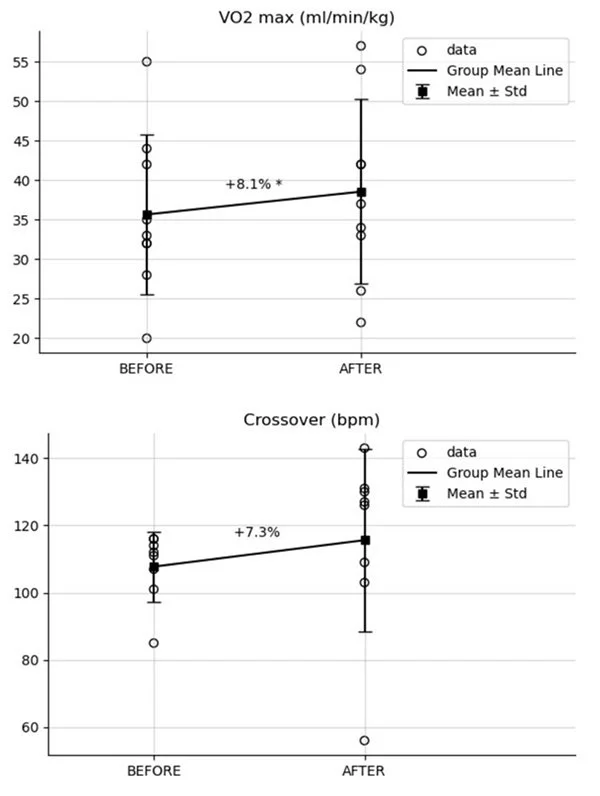
1. VO₂ Max increased by 8.1%. VO₂ max is the benchmark marker for aerobic capacity and cardiovascular fitness. An 8.1% increase after a single 10-minute session suggests a rapid improvement in oxygen utilization efficiency at peak exertion. Higher VO₂ max is strongly associated with lower cardiovascular risk and lower biological age. This strong improvement was observed consistently across all participants.
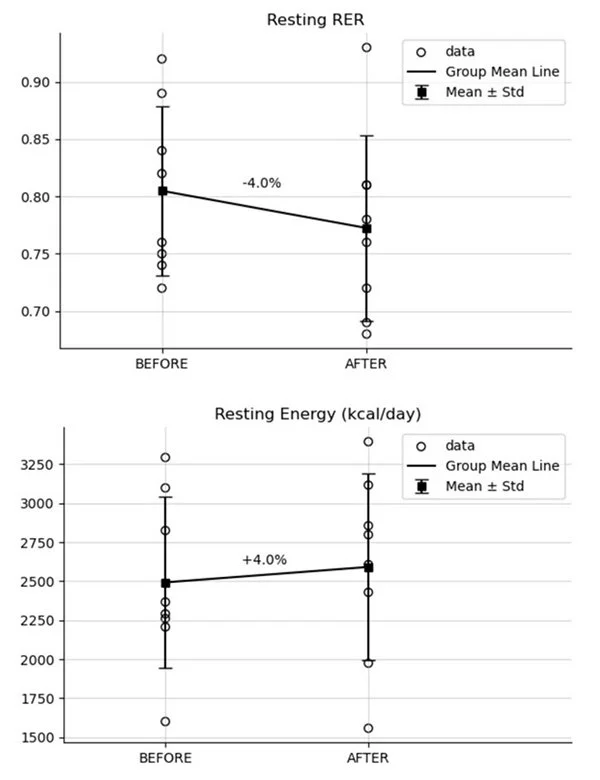
2. The Resting Metabolic Rate (RMR) increased by ~4%. Participants burned more calories at rest following the session. This indicates acute metabolic activation, not exercise-induced fatigue or stress. Even modest increases in RMR can support metabolic health, weight regulation, and mitochondrial activity if sustained.
3. The Resting Respiratory Exchange Ratio (RER) decreased by ~4%. Lower RER indicates greater reliance on fat oxidation instead of carbohydrates at rest. This suggests improved metabolic flexibility and a shift toward lipid metabolism. High resting RER is linked to insulin resistance and metabolic dysfunction; lowering it is generally favorable.
4. Crossover Point Heart Rate increased by ~7.3%. The point during exercise where the body switches from fat-dominant to carb-dominant fuel use occurred at a higher heart rate. Participants could burn fat at higher intensities post-session. This is a hallmark of improved endurance capacity and metabolic efficiency.
Analysis
After just one 10-minute Pulse XL Pro session, participants showed:
Improved oxygen utilization
Increased baseline energy expenditure
Enhanced fat metabolism at rest
Greater metabolic flexibility during exertion
Taken together, these changes indicate a coordinated acute improvement in cardiometabolic efficiency, not just a single isolated metric. The authors interpret this pattern as consistent with a “metabolically younger” physiological profile, while explicitly noting that these are acute effects. Long-term outcomes require repeated sessions and future studies.
A single 10-minute Pulse XL Pro PEMF session produced statistically meaningful, directionally favorable changes in VO₂ max, resting metabolism, fat oxidation, and exercise metabolic flexibility in healthy adults, as measured by gold-standard cardiometabolic testing.
Analysis From The Study
This study demonstrated notable improvements across multiple key cardiometabolic variables following a single 10-minute PULSE oxygen therapy session. Specifically, participants exhibited an increase in maximal oxygen uptake (VO₂ max) by 8.1%, a critical indicator of enhanced aerobic fitness and cardiovascular health. An elevation of this magnitude implies greater efficiency in oxygen utilization during peak physical exertion, potentially leading to improved endurance performance and reduced cardiovascular strain during daily activities. Resting metabolic rate (RMR), reflecting basal caloric expenditure, increased by 4%. This elevation indicates a meaningful enhancement of basal energy requirements, suggesting that participants experienced an acute metabolic activation. Such a change has important implications for energy balance, potentially benefiting weight management and metabolic health by modestly increasing daily calorie consumption without additional physical effort. Additionally, resting respiratory exchange ratio (RER) decreased by 4%, signifying a shift toward greater reliance on lipid metabolism at rest. This reduction in resting RER is indicative of enhanced fat oxidation capabilities, a metabolic adaptation highly beneficial for long-term cardiometabolic health. Enhanced lipid utilization at rest may not only improve body composition by facilitating fat loss but also contribute to improved metabolic flexibility, allowing the body to efficiently alternate between fat and carbohydrate sources based on energy availability and physical demands. Moreover, the crossover point, defined as the exercise intensity at which energy metabolism shifts predominantly from fats to carbohydrates, occurred at a heart rate that was 7.3% higher post-therapy. This upward shift of the crossover point represents improved metabolic flexibility during exercise, allowing individuals to rely more extensively on fat oxidation at higher intensities. Such a change suggests enhanced endurance capabilities and reduced dependency on carbohydrate metabolism, potentially delaying fatigue during prolonged exercise bouts. Taken together, these numerical improvements in VO₂ max, resting metabolic rate, resting RER, and crossover heart rate collectively indicate that the PULSE therapy induces favorable acute metabolic adaptations. The coordinated enhancement across these parameters highlights a comprehensive improvement in cardiometabolic efficiency and flexibility. These findings collectively suggest a metabolically younger physiological profile, potentially leading to improved health outcomes, reduced disease risk, and greater overall physical performance capacity following repeated exposure to this therapy. Future research should explore the sustained benefits of chronic therapy sessions to further validate these acute positive adaptations and evaluate their impact on long-term health markers.